Recently, Professor Xin Hao’s research team at the State Key Laboratory of Organic Electronics and Information Display, NJUPT has made a breakthrough in the field of kesterite solar cells by achieving epitaxial heterojunction interface through low-temperature annealing, significantly reducing the heterojunction interface recombination and increasing open circuit voltage and filling factors. The cell efficiency has been certified by the National Renewable Energy Laboratory (NREL) to be 13.0%, setting a new world record for kesterite solar cells.
The team also systematically studied the construction process of the heterojunction interface of kesterite cells and revealed for the first time the mechanism of defect formation at the heterojunction interface and of epitaxial heterojunction interface by low-temperature annealing. The results were published in the international academic journal Nature Energy on October 6, 2022 with the title “Elemental de-mixing-induced epitaxial kesterite/CdS interface enabling 13%-efficiency kesterite solar cells”. Prof. Xin from the School of Chemistry and Life Sciences, NJUPT, Prof. Chen Shiyou from Fudan University and Prof. Meng Qingbo from the Institute of Physics, Chinese Academy of Sciences were the co-corresponding authors, and PhD student Gong Yuancai and MS student Zhu Qiang from NJUPT were the co-first authors.
The Cu2ZnSn(S,Se)4 and CZTSSe semiconductor material with the structure of Kesterite is a new type of eco-friendly and low-cost material with great potential due to its low toxicity of constituent elements, large reserves on earth, and similar crystal structure and optoelectronic properties to those of Cu(In,Ga)Se2 and CIGS semiconductor. However, the conversion efficiency of CZTSSe solar cells has stagnated for a long time since 2013 at 12.6%, which is much lower than that of CIGS solar cells at 23.35%. The key issue limiting the performance of CZTSSe solar cells is the huge open circuit voltage loss, in which the severe nonradiative recombination at the CZTSSe/CdS heterojunction interface is one of the important reasons for the loss. However, the formation mechanism of the heterojunction interface defect remains unknown.
Xin’s team significantly improved the open circuit voltage, filling factor and photoelectric conversion efficiency of the cell by low-temperature annealing the silver-alloyed ACZTSSe/CdS heterojunctions. Various data showed that the improvement of cell performance mainly came from the reduction of defect concentration at the heterojunction interface. The intrinsic mechanism of heterojunction interface defect formation and elimination was obtained through an in-depth study of the element migration during the construction of ACZTSSe/CdS heterojunction interface and before and after low-temperature annealing. The results show that, unlike the deposition process of CdS buffer layer in CIGS solar cells where Cd2+ occupies the absorber layer indicating Cu vacancies to form shallowly buried PN junctions and grows naturally epitaxially on the CIGS surface, during the deposition process of ACZTSSe buffer layer, the Zn2+ on its surface is dissolved by NH3?H2O in the solution to form Zn-poor surface, resulting in Cd2+ occupying Zn vacancies (not Cu vacancies), and the huge difference between the ionic radii of Cd2+ and Zn2+ leads to lattice strain and the existence of Zn vacancies. Meanwhile, the Zn2+ dissolved into the solution is redeposited into the CdS buffer layer, leading to the low crystallinity of the CdS layer at the interface, and finally the ACZTSSe/CdS heterojunction interface with serious defects is formed. The low-temperature annealing leads to the migration and rearrangement of elements near the heterojunction interface, including the backmixing of Cd2+ and Zn2+ ions at the interface and the diffusion of Zn2+ from the bulk phase to the absorber layer interface. The elemental migration and rearrangement enable the gradient distribution of Zn and Cd elements near the interface, which contributes to the formation of the epitaxial ACZTSSe/CdS interface, effectively reduces the interface defect concentration and suppresses the heterojunction interface, and significantly increases the open circuit voltage and filling factor of the cell.
The work not only set a new world record efficiency (13%) for kesterite solar cell and broke the bottleneck of heterojunction interface recombination in it, but also revealed for the first time the construction process of heterojunction interface and the intrinsic mechanism of defect formation in kesterite solar cells. Moreover, the research revealed the chemical origin of the completely different heterojunction interfaces between kesterite and CIGS. The research results provided new ideas and strategies for further improvement of this type of cells. The work was financed by the National Key Research and Development Program of China, National Natural Science Foundation of China, and Shanghai Outstanding Academic Leaders Program.
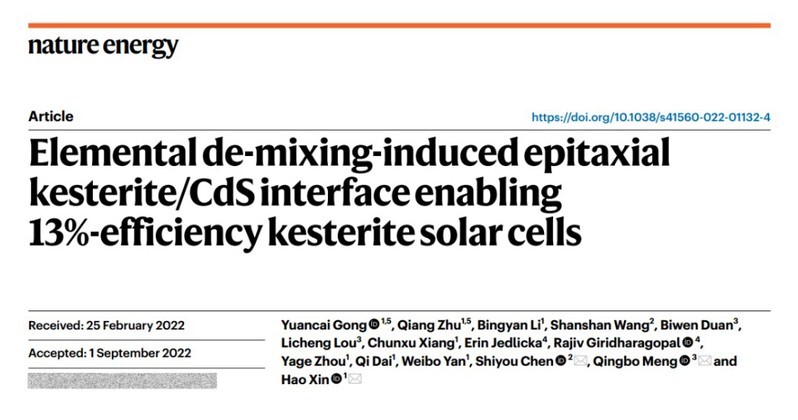
Research of Xin’s team published on Nature Energy
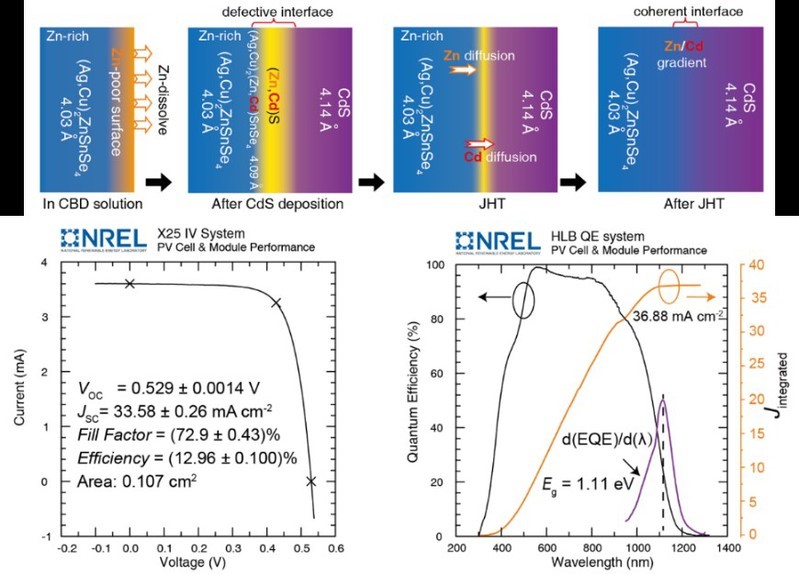
The migration and rearrangement of elements at kesterite surfaces and heterojunction interfaces
(Writer: Gong Yuancai Preliminary Reviewer: Lai Wenyong Editor: Wang Cunhong Final Reviewer: Zhang Feng)